Feature Story


Recently, the Thematic Dialogue Between the CPC and Foreign Political Parties themed "Putting People First - Mission and Responsibility of Political Parties" was jointly held by the International Department of the CPC Central Committee (IDCPC) and CPC Hebei Provincial Committee in Xingtang county, Hebei Province. About 180 people attended the meeting, including representatives from political parties, parliaments, and governments from more than 20 countries.
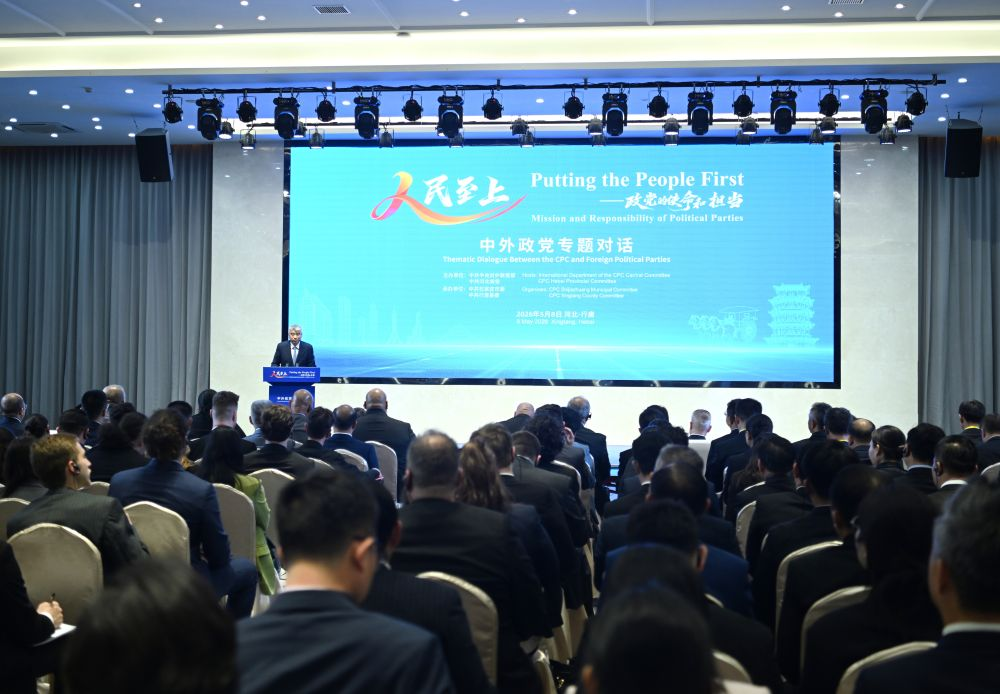
On May 8th, the Thematic Dialogue Between the CPC and Foreign Political Parties themed "Putting People First - Mission and Responsibility of Political Parties" is jointly held by the International Department of the CPC Central Committee (IDCPC) and CPC Hebei Provincial Committee in Xingtang county, Hebei Province. A college graduate who returned to his hometown Xingtang shared the development of the local jujube industry.
Nestled in mountainous areas, Xingtang is abundant in Chinese jujubes. But years ago, the jujube trees were severely plagued by jujube fruit shrink disease, which often led to total crop failures. After experts organized by the local Party committee and government succeeded in controlling the disease, CPC member Lu Yan'ge began promoting the jujubes via live-streaming in front of some ancient jujube trees to help expand market access. Within months, orders nearly tripled. He also established a cooperative with his fellow villagers, enabling veteran jujube farmers to become skilled technicians. More than 100 farming households increased their incomes, built new homes, and enjoyed increasingly prosperous lives.
After hearing the story, Maise Riley, head of the Young Cadres Delegation from Europe and the United States and national chair of the Young Communist League affiliated with the Communist Party of Britain, said Xingtang’s exploration in enriching local residents through industrial development had provided a practical reference for addressing rural development challenges and safeguarding grassroots interests in the UK. He noted that the CPC has always placed the people’s needs first, pursuing practical and sustained efforts.
In recent years, Xingtang has continuously expanded channels for increasing people’s incomes by developing traditional Chinese medicinal herb cultivation and agricultural product processing industries based on local characteristics. Profound changes have taken place in rural areas, reflecting China’s solid progress from poverty alleviation to rural revitalization.
China’s top-down and bottom-up coordinated practices in poverty alleviation and rural revitalization are of great research value, said Sisouphanh Keobandavong, Member of the Party Leadership Group and Director of the Supervision Department of the Ministry of Foreign Affairs of Laos. Laos still faces arduous tasks in poverty reduction and should learn from the valuable experience of the CPC in leading the people to win in the battle against poverty, always taking people’s well-being as the ultimate goal and formulating clear strategic objectives.
The CPC's efforts in improving people's livelihoods also won high praise from participants from afar. Reyna Rueda, head of the delegation of Sandinista National Liberation Front and Mayor of Managua, Nicaragua’s capital, said China’s achievement in lifting nearly 100 million people out of poverty and establishing the world’s largest social security system demonstrates that a people-centered strategy can fundamentally transform a nation, reduce poverty and advance common prosperity.

On May 8, participants of the Thematic Dialogue visit Hebei Bokeer electric technology co., ltd. in Xingtang, Hebei Province.
Many stories in Xingtang illustrate this development path. Officials appointed to temporary posts helped boost the development of farms for egg-laying hens, creating stable incomes for more than 3,000 formerly impoverished households. Rural women attended free vocational training programs and supported their families through childcare and nursing skills.
Lord Vaea, Speaker of Tonga's Parliament, observed that China’s development places great importance on “investing in people.” He said, people’s real experience matters most, including support for families, improvement of people’s livelihood and enhanced community resilience.
These tangible changes gave foreign representatives a more vivid understanding that the fruits of development are shared by the people.
At the Thematic Dialogue, keywords such as “people,” “development,” “poverty reduction” and “governance” echoed repeatedly in different languages, while mutual understanding deepened through exchanges. Many participants said the event helped them better appreciate how good governance, institutional support and long-term planning can reinforce one another.
Although the dialogue has concluded, enthusiasm for learning from China’s development experience remained strong. Some foreign participants planned visits to Tayuanzhuang village in Zhengding county to learn more about governance at grassroots level, while others intended to tour traditional Chinese medicine enterprises in Shijiazhuang city. Some had already purchased high-speed rail tickets to Yan’an in Shaanxi Province, hoping to further explore the enduring vitality of the CPC.


Follow us:







Copyright © 2003 International Department of Central Committee of CPC. All rights reserved.
Email:info@idcpc.org.cn